Timeless pieces. No logos. No noise.

The Accessories That Matter: Building a Quiet Luxury Collection That Lasts
Quiet luxury accessories speak without shouting. Learn which pieces anchor a refined wardrobe for decades: the leather belt, the simple watch, the signet ring, and the wool scarf. Discover what to skip entirely and why restraint builds lasting style.
In this article9 sections
- The Leather Belt: Foundation and Anchor
- The Watch: Reliable and Readable
- The Signet Ring: Personal, Not Ornamental
- The Wool Scarf: Seasonal Refinement
- The Silk Pocket Square: Context Dependent
- What to Skip: The Accessories That Do Not Belong
- Building Investment: Cost Per Wear and Time Horizon
- The Discipline of Accessories
- Frequently asked questions
Accessories in the old money tradition do not announce themselves. They settle quietly into a wardrobe, earn their place through restraint and durability, and improve with time. The philosophy is simple: each piece must justify its existence through uncompromising quality and genuine utility. A bracelet for flash has no home here. A watch worn daily, returned to for three decades, does.
The difference between a wardrobe that feels expensive and one that actually is rests not in the clothing itself, but in what you choose to add. Most people accumulate too much and think too little. The quiet luxury accessories essentials follow an inverse principle: fewer pieces, chosen with absolute precision, each carrying more weight than a dozen trend-driven alternatives.
The Leather Belt: Foundation and Anchor
A belt should disappear into your wardrobe. Not because it goes unnoticed, but because its quality becomes so natural that you stop thinking about replacing it. The leather belt in quiet luxury accessories essentials dressing serves two functions: it holds your trousers in place, and it establishes a tonal anchor between your shoes and the rest of your silhouette.
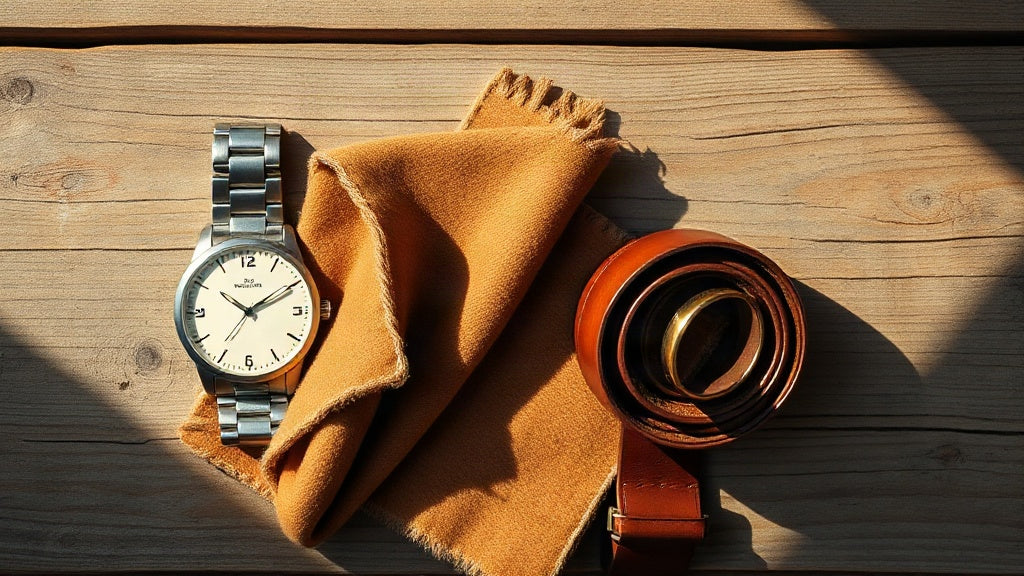
Choose chocolate brown or burgundy leather. These colors work across seasons and coordinate with the shoes you already own. Black feels harsh when done without intention; save it for moments requiring real formality. The width should be modest, around 1.25 inches. Wider belts invite the eye to linger; narrower ones disappear. The buckle should be simple metal, nothing engraved, nothing ornamental. A polished silver or brushed gold buckle works with nearly everything. The leather itself matters more than the buckle ever will.
Full-grain leather, burnished and left slightly imperfect, ages better than anything treated for pristine appearance. Scuffs become character. Creases settle into the leather and tell the story of a life lived. A belt purchased in your thirties can accompany you into your sixties, its patina becoming evidence of consistent, unhurried choices.

Avoid trends in belt styling. The braided belt, the chain-link, the logo-heavy versions: all carry an expiration date written into their aesthetic. A simple leather belt, replaced only when the leather genuinely fails, costs almost nothing per year of wear. That arithmetic rewards patience over impulse.

The Watch: Reliable and Readable
Few accessories receive as much false philosophy as watches. Marketing suggests that a watch defines your taste, your aspirations, your place in society. In the old money world, a watch is simpler than that: it tells time accurately, it wears well, and you do not think about it often.
Look for a stainless steel or polished steel case, 38-42mm in diameter. Avoid anything larger; a watch worn on the wrist should not command the same visual weight as your actual clothing. The dial should be understated: white or cream, with clear numerals or indices. A date window is practical; a chronograph is not. Automatic or quartz matters far less than consistency. A reliable quartz watch worn for four decades outperforms a prestigious automatic abandoned after seven years.
The strap matters. Leather, if treated well, improves with age. A leather strap six years into wear sits differently on the wrist than a new one. Metal bracelets have their place, but leather connects the watch to your skin more directly, and that contact reinforces the habit of checking it, reading it, knowing the time by true habit rather than reflex. A watch you wear without thinking about wearing it has done its job.
Stainless steel holds up better than any fashion watch. It scratches, yes, but those scratches become evidence of hours spent. The dial should not require explanation. If you find yourself telling someone what brand it is or what it cost, it is doing too much talking for you.

The Signet Ring: Personal, Not Ornamental
A ring worn to signal wealth is a ring worn too loudly. The signet carries meaning differently. Historically a seal, it became a marker of personal identity, family heritage, or professional standing. In contemporary practice, it lives most comfortably on the pinky finger of the non-dominant hand, visible in certain contexts and absent in others depending on your position and movement.
The signet should be gold or silver, polished or matte depending on the context of your daily life. A working professional in an office benefits from a subtler matte finish; someone in creative fields might carry polish. The stone or seal face can be engraved with initials, a family crest, or left blank. The blank version offers flexibility: it becomes whatever you want it to represent rather than declaring a specific identity.
Scale matters. A signet ring too large appears costume-like. Too small and it disappears into the hand. The seal face should be roughly the size of a fingernail, no larger. The band itself should be robust enough to withstand decades of wear without bending. This is not a delicate piece. It is built for use and passage through time.

🗂️ The collection
Old Money Jewelry
Signet rings, watches, and understated pieces that anchor a refined wardrobe for decades without demanding attention.
16 products
The Wool Scarf: Seasonal Refinement
A scarf exists in the old money wardrobe only when it serves a genuine purpose. Not for display, not for a moment of self-expression on a Tuesday. A scarf appears when the weather turns, when you reach for a coat, when the context shifts toward formality or particular elegance.
Camel and navy represent the only necessary colors. Camel wool worn with a charcoal suit or dark trousers creates a subtle vertical line that lengthens the torso. Navy worn against ivory or cream grounds the outfit in restraint. These combinations work because they do not require thought. You reach for the scarf, drape it, and move forward with your day.
The weight matters. A heavy wool scarf in winter carries warmth in its density; a lighter weave suffocates. Look for a scarf woven densely enough to hold warmth but loosely enough to breathe. The length should reach perhaps six inches below the collarbone when draped once around the neck. Long enough to anchor, but not so long that it becomes theatrical.
A scarf worn indoors is a scarf announcing itself. The quiet luxury accessories essentials version appears when genuinely needed and disappears the moment you enter a heated space. It is not an accessory for visual effect but for thermal and tactile comfort. The finest scarves are barely noticed until you need them, at which point they become indispensable.
The Silk Pocket Square: Context Dependent
A pocket square belongs inside a jacket, not outside it. Worn in the breast pocket where only someone standing very close to you will see it, a silk pocket square serves as a private refinement rather than a public statement. It appears in tailored settings: business meetings, formal dinners, occasions where precision matters.
Choose white, cream, or a subtle pattern in navy and white. The pattern should be small enough to read as texture rather than design. Avoid anything loud or novelty-printed. The silk itself should have weight, draping slightly rather than holding stiff edges. A pocket square that looks sharp and artificial defeats its purpose.
The fold matters less than people suggest. A simple triangle, pointing slightly upward from the pocket, works in nearly every context. Complicated folds invite scrutiny and steal attention from the larger picture of your appearance. If someone notices your pocket square more than they notice you, something has gone wrong with proportion and restraint.
What to Skip: The Accessories That Do Not Belong
Bracelets in the quiet luxury wardrobe require justification most people do not have. A chain worn on the wrist, metal or otherwise, introduces a visual break in the line from shoulder to fingertip. It catches light in ways that compete with your actual clothing. It makes noise. It requires adjustment. The cost in attention exceeds any benefit.
Statement sunglasses fall into the same category. Regular sunglasses, dark, simple, frames that match your face shape without declaring anything, belong on a sunny day. But oversized frames, bold colors, or branded pieces announce the wearer rather than serving the wearer. Utility, not visibility, should drive your choice.
Chains worn as necklaces over clothing live outside the old money tradition. A chain carries implications of status or self-direction that conflict with understated elegance. If you wear jewelry at the neck, let it be simple and close to the skin: a small pendant, nothing more. The chain by itself, visible and swinging, says too much.
Avoid the impulse to layer accessories. One signet ring plus a watch plus a belt represents a complete everyday collection for most days. Adding a scarf, a pocket square, and a necklace begins to create visual noise. Restraint means knowing when to leave off, not knowing how to add more.
Building Investment: Cost Per Wear and Time Horizon
The economics of quiet luxury accessories essentials differ entirely from trend-driven purchasing. A leather belt that costs forty dollars and lasts thirty years costs you about one dollar per year. A watch purchased at eighty dollars and worn for forty years costs two dollars per year. A signet ring chosen once and worn for a lifetime costs almost nothing when amortized across decades.
Compare this to the person who buys five belts across five years, replacing them as trends shift or they wear out prematurely. The cost per wear rises sharply. The accumulated waste, both financial and environmental, multiplies. The quiet luxury approach inverts the logic entirely: buy less, choose better, keep longer.
This means spending more upfront on quality leather, on watches built by manufacturers with track records, on metals that will not tarnish or fade. But the true cost of ownership, measured in years and decades, remains far lower than the alternative. A useful cross-reference: the same patience applied to footwear is explored in the old money shoes guide.
The Discipline of Accessories
Wearing the same leather belt to work every day requires discipline. It requires resisting the constant pull of novelty. It means passing by storefronts displaying seasonal accessories and knowing that nothing there will improve your life. It demands that you trust your choices enough to repeat them without apology.
This is where quiet luxury truly lives. Not in expensive materials or famous names, but in the willingness to wear the same things, refined things, until they become invisible through familiarity. That invisibility carries its own authority. People remember you, not your accessories. Your clothes settle into the background as part of who you are.
The accessories that matter most are the ones you do not think about. They work so well that you forget to consider replacing them. They age in ways that improve rather than diminish their value. They anchor your style in restraint and consistency rather than in moments of impulse or trend. This is the quiet standard that separates a considered wardrobe from a merely expensive one.
Frequently asked questions
What defines quiet luxury accessories?+
Quiet luxury accessories prioritize quality materials, restrained design, and genuine utility over visual impact. They speak through durability and refinement rather than logos or trend-driven styling. Each piece should justify its existence through decades of use.
Can I wear multiple accessories at once?+
Yes, but with restraint. A watch, signet ring, and belt form a complete everyday collection. Add a scarf only in cold weather or formal settings. A pocket square appears only within a tailored jacket. The goal is harmony, not accumulation.
How long should quality accessories actually last?+
A leather belt should last 20-40 years with proper care. A watch can function reliably for 30-50 years or more depending on the movement. A wool scarf, worn seasonally and cared for properly, improves over decades. A signet ring, if made from quality metal, lasts a lifetime and beyond.
Should I invest in luxury brand accessories?+
Brand reputation matters less than material quality and construction. A well-made steel watch from a lesser-known manufacturer will outperform a logo-heavy alternative of poor build quality. Focus on leather weight and tanning methods, metal purity, and reviews from people who have owned the piece for years.
What is the cost-per-wear calculation for accessories?+
Divide the total cost by the number of years you expect to wear it. A $40 leather belt worn for 30 years costs approximately $1.33 per year. A $80 watch worn daily for 40 years costs about $2 per year. This calculation reveals why investing in quality initially saves money over time.
How do I care for a full-grain leather belt?+
Wipe it clean with a dry or very slightly damp cloth after heavy use. Apply a neutral leather conditioner two or three times a year to prevent the leather from drying and cracking. Store it flat or loosely coiled, never folded sharply. Avoid prolonged exposure to direct sunlight, which fades and dries vegetable-tanned leather faster than natural wear does.
Shop the edit
Old Money Watches
Pieces from our Old Money Watches collection, chosen to go with this article.