Timeless pieces. No logos. No noise.

How to Wear a White Linen Shirt: A Man’s Practical Guide
The white linen shirt is the warm-weather counterpart to the oxford cloth button-down: deceptively simple, easy to get wrong. Isabel Montclair on fabric weight, sleeve roll technique, and three outfit frameworks that hold across settings.
In this article10 sections
- What Linen Actually Is, and Why Fabric Weight Changes Everything
- How a White Linen Shirt Should Fit
- The Undershirt Question
- Three Outfit Frameworks That Hold
- The Sleeve Roll: One Technique That Reads Well
- Button Placement and the Collar Open Question
- Colour Pairings Worth Knowing
- Caring for White Linen So It Lasts
- Where the White Linen Shirt Belongs in a Longer Wardrobe Logic
- FAQ
A white linen shirt is one of those garments that looks effortless on the right person and slightly chaotic on everyone else. The fabric is alive in a way cotton poplin is not. It moves, breathes, wrinkles. Those wrinkles are not a problem to be solved. They are the whole point. But there is a difference between a shirt that has settled into itself and one that simply looks forgotten. Getting a white linen shirt right for men comes down to three things: understanding the cloth, choosing the correct fit, and knowing which outfits actually work across contexts.
What Linen Actually Is, and Why Fabric Weight Changes Everything

Linen comes from the flax plant. The fibers are long, hollow, and exceptionally moisture-wicking, which explains why the fabric feels cool against the skin even at 85°F. It absorbs up to 20 percent of its weight in moisture before it feels damp. That is the practical reason linen has been a warm-weather cloth for centuries, from Egyptian antiquity through the summer wardrobes of British colonial administrators.
The number most buyers overlook is fabric weight, measured in grams per square meter (gsm). A shirt at 140-155 gsm will be sheer enough that a dark undershirt will read through. That is a specific problem with white linen in particular. A cloth at 175-200 gsm holds its shape through the chest and drapes without clinging, while remaining genuinely breathable. Anything above 220 gsm starts to feel more like a structured overshirt; still useful, but a different garment.
Linen also varies by weave. A plain weave gives a flat, slightly formal surface. A slubbed weave, where the natural irregular fibers are left visible, produces a textural surface that reads casual. For a white shirt worn in resort or weekend contexts, slubbed linen is appropriate. If the shirt is going to a business-casual environment or worn under a linen blazer, a smoother plain weave holds its composure better.
There is one further distinction worth making: European linen, particularly from Belgium and Ireland, tends to be spun from longer flax fibers, which produces a finer hand and greater tensile strength. The cloth lasts longer and softens more gracefully. This is not snobbery; it is a practical observation about fiber length and how it determines wear over time. A shirt in Belgian linen at 190 gsm will outlast three shirts in a blended linen-cotton at 155 gsm and feel considerably better in year three than it did in year one.
How a White Linen Shirt Should Fit
The most common mistake with linen shirts is wearing them too large in the belief that volume equals breathability. It does not. A shirt two sizes too large bunches at the waist when tucked and looks shapeless when untucked. The correct fit for a white linen shirt worn in the quiet luxury register is relaxed but intentional.
The shoulder seam should sit at the end of the shoulder bone, not partway down the upper arm. The chest should have 3-4 inches of positive ease when buttoned, enough to move freely but not so much that the fabric pools. The body length matters for the untucked question: a shirt hemmed with a curved shirttail is designed to be worn tucked; a straight hem can go either way.
Collar construction is where most fast-fashion linen shirts fail. Without proper interlining, a linen collar collapses within an hour of wearing. The collar points curl upward. For an open-collar shirt worn without a tie, this reads as careless rather than relaxed. Check that the collar has at least a light fusible interlining, or choose a band collar or camp collar silhouette, which sidesteps the problem entirely.
Sleeve length is another point of failure. A linen shirt cut with a sleeve that hangs past the wrist bone looks unfinished. The correct length positions the cuff at the wrist bone when the arm hangs naturally. When rolled, which is the default for warm-weather wearing, the cuff should land just below the elbow with the cuff fabric showing as a visible border. A sleeve cut too long produces a sloppy roll; one cut correctly rolls once and stays.
The Undershirt Question
Wearing a white linen shirt without thinking about what goes underneath is where the look falls apart. The short answer: in most cases, skip the undershirt. A well-weighted white linen shirt at 175 gsm or above is opaque enough to wear without one, and a crew-neck undershirt creates a visible ring at the collar that conflicts with an open neckline.
There are two exceptions. If the shirt is genuinely sheer, a fitted white V-neck in thin jersey can work, provided the V drops far enough not to show. The second exception is physical activity, where an undershirt manages perspiration and keeps the outer shirt drier. In that context, a lightweight merino V-neck is the most discreet option.
For most summer situations, opting for a properly weighted shirt eliminates the question completely. The right cloth is the answer; the undershirt is the workaround.
Three Outfit Frameworks That Hold

Matching a white linen shirt to the right bottom and footwear is where personal style either clarifies or muddles. Three frameworks cover the range from afternoon drinks to formal garden lunch.
The Resort Framework: Tailored Shorts
A white linen shirt worn with tailored shorts in a warm neutral is the cleanest warm-weather outfit a man can put together. The key word is tailored: the shorts should have a proper waistband, a slight taper through the thigh, and a hem that falls above the knee. Chino shorts in camel, olive, or sand work. Drawstring shorts do not.
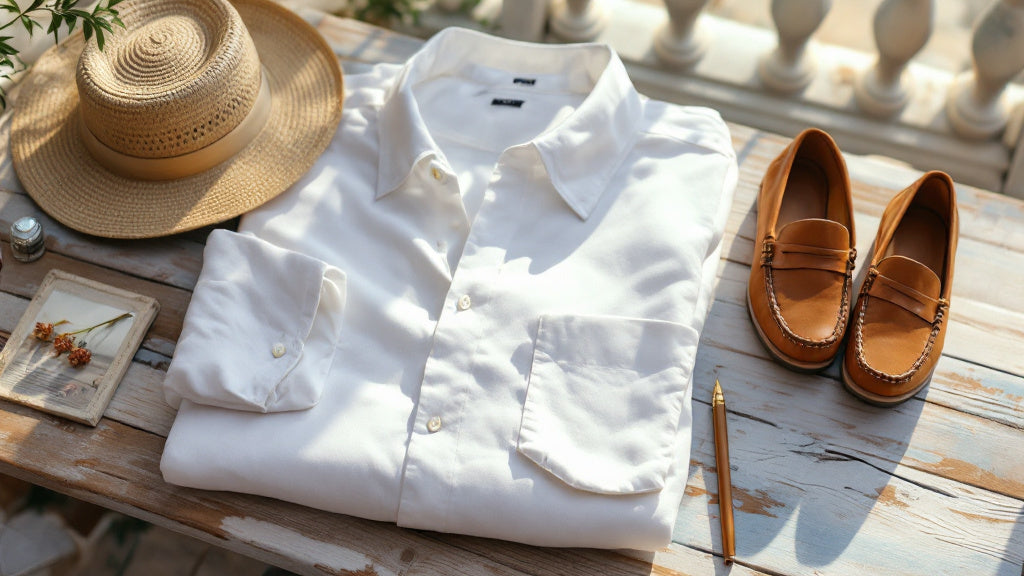
The shirt can be worn open over a plain white or camel crew-neck tee, or buttoned to one button below the collar and left untucked. Either way, the hem should not extend below the top of the shorts pocket or the proportions become awkward. Footwear here is suede or leather loafers, not flip-flops. A simple leather sandal is acceptable on a beach or terrace; espadrilles work in the south of France.
The Casual Framework: Chinos Rolled
Chino trousers in stone, khaki, or sand are the default pairing for a white linen shirt in a non-resort context. The trousers should be slim or straight through the leg, not tapered to the point of restricting movement. A single roll at the hem, about 1.5 inches, adds a considered informality without tipping into affectation.
The shirt works tucked or untucked here. Tucked reads slightly more composed, particularly if the chinos have a clean front crease. Untucked reads relaxed but requires the shirt length to be appropriate. Half-tuck, one side in one side out, is rarely a good idea; it tends to look accidental rather than deliberate.
A pair of linen trousers in a complementary neutral can substitute for chinos and leans the whole outfit toward a more monochromatic register, which carries its own quiet authority. Navy chinos offer more contrast and pull the shirt toward a slightly more American-preppy territory.
The Warm-Weather Elegance Framework: Linen Suit or Separate Blazer
The most formal use of a white linen shirt for men is as the base layer of a full warm-weather suit. A natural-shoulder linen blazer in cream, tan, or pale grey worn over the same white shirt with matching or coordinating linen trousers is a complete outfit that reads appropriately for outdoor weddings, garden parties, and summer business occasions in warm climates.
In this context, the shirt is worn fully buttoned with the collar open, no tie. The proportions work because the jacket provides the structure the shirt alone cannot. The shirt should be tucked. A slim leather belt in tan or cognac closes the waist without interrupting the line. See the tailored trouser options that pair cleanly with this approach.
The Sleeve Roll: One Technique That Reads Well

The sleeve roll on a linen shirt is not purely cosmetic. Linen wrinkles at the elbow crease regardless of how carefully the shirt is pressed, so rolling the sleeve avoids the folded-paper look that appears after thirty minutes of movement. There is one roll that works and several that do not.
The correct version: unbutton the cuff, fold it back once to approximately double its original depth, then fold it back again so the cuff sits just below the elbow. The cuff should be visible, not hidden inside the roll. This creates a clean, intentional finish with the cuff fabric showing as a border at the top of the roll.
What does not work: the “army roll,” where the cuff is rolled under and tucked inside itself. It looks effortful and tends to fall apart during the afternoon. Also avoid rolling above the elbow on a dress shirt; that reads as kitchen work rather than considered dressing.
One cuff rolled and one left down is never appropriate. Both sleeves should match.
Button Placement and the Collar Open Question
How many buttons to leave open at the collar is a question that affects the character of the entire outfit. One button open reads relaxed but composed, appropriate for most settings. Two buttons open reads resort and works with shorts or linen trousers on a warm afternoon. Three or more reads either beach or careless, depending on the context.
The specific shape of the collar matters here. A spread collar with two buttons open shows more chest and works better on men with broader builds. A classic point collar with one button open sits flatter and reads more refined. A camp collar, with its open notch that sits outside the shirt rather than folding back, is designed to be worn fully open or worn as the top layer of the outfit without any button at all.
“Dress should look unselfconscious, with hints of consciousness at appropriate points.”
Observed in men’s style discourse, broadly attributed to the sprezzatura tradition
The collar tension is the one place where that principle is most visibly tested.
Colour Pairings Worth Knowing
White linen reflects light and absorbs the tones around it. This makes colour pairings unusually important. The safest ground is tonal: cream, ivory, sand, camel, taupe, and stone all sit within a degree of white without competing. A white shirt with cream chinos and tan loafers reads as a composed whole.
| Bottom | Footwear | Register |
|---|---|---|
| Cream or stone chinos | Suede loafers in tan or cognac | Tonal, composed, resort-casual |
| Olive chinos or linen trousers | White leather sneaker or suede derby | Earthy contrast, weekend-casual |
| Navy chinos or tailored shorts | Penny loafer in brown or burgundy | Nautical contrast, classic American |
| Linen suit in pale grey or tan | Oxford shoes or leather loafer | Smart occasion, garden party, outdoor wedding |
| Charcoal or dark olive trousers | Brown leather boots or derby | High contrast, transitional season |
Avoid pairing white linen with black trousers. The contrast is too stark for linen’s inherent softness; it looks borrowed rather than considered. Burgundy and deep plum work as accent colours in accessories, not as trouser options.
Caring for White Linen So It Lasts
Linen is more durable than it looks, but white linen specifically requires some attention. Machine wash on a cool cycle (30°C/86°F) rather than hot. Hot water accelerates the yellowing that affects white linen over time, caused by natural fiber oxidation rather than poor washing. A small amount of oxygen-based brightener every few washes maintains the white without the damaging chlorine bleach cycle that breaks down linen fibers.
Press while still slightly damp. Linen responds to a medium-hot iron much better than to dry ironing. Steam alone on a bone-dry linen shirt leaves creases resistant. The collar and cuffs need direct pressure; the body of the shirt can be steamed lightly if a fully pressed look is not required.
Hang immediately after washing rather than leaving in the machine or dryer. Linen dries fast in open air and often requires less pressing as a result. A dryer on high heat will shrink linen and accelerate wear at the seams. If the shirt must go in the dryer, use low heat and remove while still slightly damp.
For storage, fold or hang: both are fine. Hanging on a wooden hanger preserves the shoulder shape better for long-term storage. If folded, place the shirt on top of the stack rather than at the bottom to avoid deep compression creases.

Where the White Linen Shirt Belongs in a Longer Wardrobe Logic
The white linen shirt earns its place not by filling a seasonal gap but by holding its own across a wider system of dressing. It works as a base layer under a navy blazer in early September when the heat has not fully left. It works as a beach overshirt when the sun drops. Worn half-buttoned over a plain white or camel crew-neck tee, it reads as a considered outer layer rather than a warm-weather afterthought.
The garments it connects to matter. A well-fitting pair of suede or leather loafers extends the register upward. A watch with a leather or linen strap, rather than rubber, keeps the tone consistent. A slim leather belt in tan or cognac, when the shirt is tucked, is the one accessory that actually closes the look. See the accessories that complement a linen shirt outfit without announcing themselves.
There is a discipline in building around a white linen shirt that most wardrobe guides skip over. The shirt functions as a neutral anchor: it asks everything around it to be considered. The trouser weight, the shoe leather, the watch strap. None of these decisions is difficult; they simply require being made. A person who wears a white linen shirt well has usually made them already, probably a few seasons ago, and has stopped thinking about it.
The white linen shirt does not try to do too much. That restraint is exactly why it keeps appearing, summer after summer, in the wardrobes of people who dress with some deliberateness. It asks to be worn, not fussed over. The wrinkles are evidence of that.
FAQ
Should a men’s linen shirt be tucked or untucked?+
Both are acceptable depending on context and hem shape. A shirt with a curved shirttail is designed to be tucked and looks unfinished when left out. A straight hem can go either way. For casual pairings with shorts or rolled chinos, untucked works; for tailored trousers or when worn under a blazer, tucked reads more composed. The hem should not fall below the trouser pocket opening when untucked.
Do you wear an undershirt with a white linen shirt?+
Generally not. A properly weighted white linen shirt at 175 gsm or above is opaque enough to wear without one. An undershirt with a crew neckline will show at the collar when the top button is open, which conflicts with the open-collar look most linen shirts call for. If the shirt is genuinely sheer, a white V-neck in thin jersey is the most discreet solution, provided the V drops far enough not to show at the chest opening.
How should a linen shirt fit on a man?+
Relaxed but intentional. The shoulder seam should land exactly at the shoulder bone, not partway down the upper arm. The chest should have 3-4 inches of positive ease when buttoned. The body should not pull at the midsection when seated or reaching. Avoid the instinct to size up for “breathability”: a shirt too large looks shapeless whether tucked or untucked, and linen’s open weave provides breathability regardless of fit.
Does linen wrinkle badly and is that a problem?+
Linen wrinkles readily. That is a property of the fiber, not a defect. The distinction to understand is between a shirt that has settled naturally into soft creases during wear and one that is visibly crumpled from being stored incorrectly. Start with a pressed shirt, and the wrinkles that develop during the day read as relaxed rather than neglected. Rolling the sleeves addresses the worst crease point, which is always the elbow.
What shoes work best with a white linen shirt outfit?+
Suede loafers in tan or cognac are the most versatile choice across casual and smart-casual contexts. Leather penny loafers in brown or burgundy lift the outfit toward a more formal register. White leather sneakers work in a weekend-casual context when paired with olive or stone chinos. Avoid white rubber-soled sneakers with linen trousers or a blazer: the contrast in formality pulls the outfit apart. Espadrilles and leather sandals are appropriate specifically for beach or terrace settings.
What fabric weight should a white linen shirt be for men?+
175-200 gsm is the practical range for a white linen shirt worn as a standalone garment. Below 155 gsm the cloth becomes sheer enough to show a dark undershirt or tanned skin through the weave, which is particularly visible in white. Above 220 gsm the shirt starts to behave more like a structured overshirt. For most warm-weather dressing, 185-195 gsm in a plain or lightly slubbed weave is the point where drape, opacity, and breathability are all in balance.
Shop the edit
Old Money Shirts
Pieces from our Old Money Shirts collection, chosen to go with this article.